Romania is big - 238,000 km², the size of the United Kingdom - and most people see a thin slice of it: Bucharest, Bran Castle and perhaps Brașov. The country behind that slice is one of the most rewarding in Europe: fortified Saxon villages in Transylvania, painted monasteries in Bucovina, wooden churches in Maramureș, the wildest stretch of the Carpathians, and the Danube Delta, the largest wetland in Europe.
It is also where Europe's last big predators live. Romania has the largest brown bear population in the EU, which makes the mountains feel genuinely wild - and means some simple rules about bears matter. Romania joined the Schengen area fully in January 2025, so for most visitors there is no longer a border check on the way in from the rest of the EU.
When to go, honestly
Late May to September for the mountains; the two famous high roads, the Transfăgărășan and the Transalpina, are only open in summer - the Transfăgărășan reopened on 12 June in 2026 and usually closes at the end of October, and even when open it runs only from 7am to 9pm. June and September are the best months overall: green, warm and uncrowded. July and August are hot in Bucharest and the plains but fine in Transylvania.
Autumn in the Carpathians is spectacular and underrated. Winter is proper winter: skiing at Poiana Brașov and Sinaia, Christmas markets in Sibiu and Brașov, and Maramureș at its most traditional over the Christmas and New Year holidays. The Danube Delta is best in May and June for birds, and in September for calm water and fewer mosquitoes.
Five Romanias
It is a big country, and it rewards picking two or three of these rather than trying all five.
Transylvania. The heart of any first trip. Brașov under its mountain, Sibiu with its houses whose roof windows look like eyes, and Sighișoara, a lived-in medieval citadel where Vlad the Impaler was born. Around them, the Saxon villages with fortified churches - Viscri, Biertan and five others are UNESCO-listed - and castles: Bran (sold as Dracula's, with little to justify it), Peleș in Sinaia (the one that is actually worth the queue), Corvin in Hunedoara, and Râșnov's hilltop citadel.
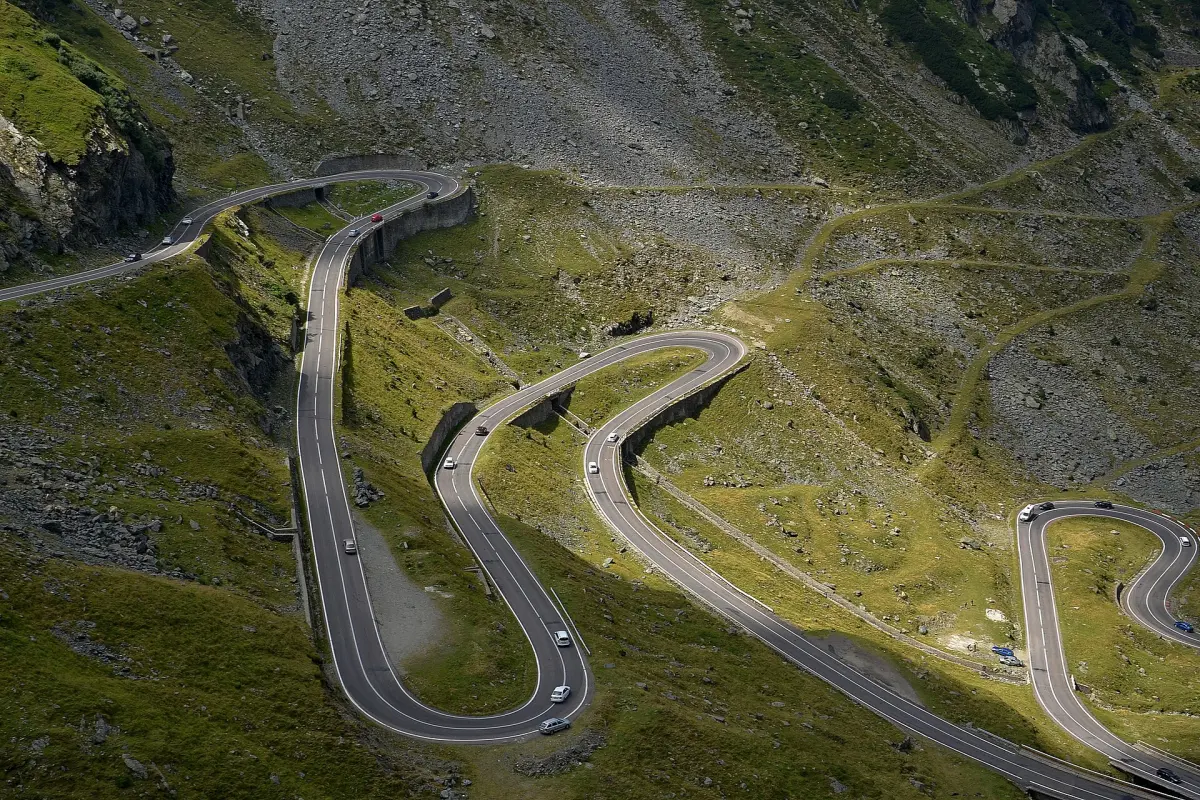
The Carpathian roads. The Transfăgărășan climbs the Făgăraș mountains in hairpins to Bâlea Lake at 2,034 m, through a tunnel and down the other side past the Vidraru dam. The Transalpina, further west, is higher (it tops out at 2,145 m) and wilder. Both are summer-only, both are best early in the morning, and both have bears by the road - see below.
Maramureș and Bucovina. The north. Maramureș has eight UNESCO wooden churches with steeples like witches' hats, carved gates, and the Merry Cemetery at Săpânța, where every blue wooden cross has a painted, often funny, epitaph. Bucovina, to the east, has monasteries painted inside and out in the 1500s - Voroneț's blue is the famous one - that still glow.
The Danube Delta. Where the Danube meets the Black Sea, a UNESCO-protected maze of channels, reeds and lakes with over 300 bird species, including pelican colonies. Tulcea is the gateway; Sulina, Crișan and Mila 23 are villages reached only by boat. The Black Sea coast south of it is busy in summer and not the reason to come.
Bucharest. Messy, loud and more interesting than its reputation: the Palace of the Parliament (one of the largest buildings in the world, and a tour through it explains the Ceaușescu era better than any museum), belle-époque boulevards, the old town's bars, and the open-air Village Museum with houses brought from across the country.
About the bears
Romania has somewhere around 8,000 brown bears, and in the Făgăraș and around Brașov they regularly come to roadsides and even town edges, drawn by food left by people. On the Transfăgărășan in particular, bears wait by the road for handouts. Do not stop to feed or photograph them from outside the car, do not leave food at picnic spots, and on trails make noise and carry bear spray in the remote areas. Feeding a bear is illegal and carries fines of RON 10,000-30,000 - about €2,000-6,000 - and there are injuries every summer; in June 2026 three people were hurt in two separate incidents on the Transfăgărășan in a single day.
None of this is a reason not to go. It is a reason to watch from the car, and to consider a guided bear-watching hide instead, near Brașov or Zărnești, where rangers make it safe and the bears are genuinely wild.
What to eat and drink
Romanian food is hearty and rural: sarmale (cabbage rolls, served with mămăligă - polenta - and sour cream), ciorbă (sour soups, the tripe one included, which is better than it sounds), mici (grilled skinless sausages) at every roadside, and papanași, fried doughnuts with sour cream and jam, for dessert. In the Delta, fish soup and carp grilled on a board.
Romanian wine is serious and cheap: Fetească Neagră among the reds, Fetească Albă and Tămâioasă among the whites, from regions like Dealu Mare and Recaș. Țuică and pălincă are the plum brandies, and in Maramureș a guest is rarely allowed to leave without one.
Where everything is
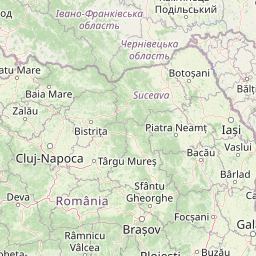
Every place named in this guide, on one map. Distances here are short - that is the whole planning trick.
Romania itineraries, by the kind of traveller you are
Four plans for the same country. They are written as schedules because the hard part here is not what to see, it is what order to see it in.
First time here
6 days
Two nights Brașov, one Sighișoara, two Sibiu, one flexible
Day 1Bucharest to Brașov via Sinaia. Fly into Bucharest, drive or take the train up the Prahova valley. Stop at Peleș Castle in Sinaia (closed Mondays), then evening in Brașov's Council Square.
Day 2Castles around Brașov. Bran early to beat the coaches, then Râșnov citadel. Back in Brașov, ride the cable car up Tâmpa for the view.
Day 3Saxon villages to Sighișoara. Viscri's fortified church on the way, then Sighișoara's citadel and the clock tower. Sleep inside the walls.
Day 4Biertan and Sibiu. Biertan's church on a hill, then Sibiu - the Large and Small squares and the Bridge of Lies.
Day 5The Transfăgărășan. In season (mid-June to October): drive up to Bâlea Lake and down to the Vidraru dam, then back. Go early. Out of season, the ASTRA open-air museum outside Sibiu instead.
Day 6Back or onward. Sibiu has its own airport with European flights, which saves the long drive back to Bucharest.
Cluj (CLJ) and Sibiu (SBZ) airports put you straight into Transylvania - often cheaper and a lot closer than Bucharest.
Road trip, north and wild
7 days
A car; Cluj, Maramureș, Bucovina and back through the Carpathians
Day 1Cluj-Napoca. A lively university city. The botanical garden and the old centre, and the Turda salt mine - an underground theme park in a salt cavern - just south.
Day 2Into Maramureș. The wooden churches of Bârsana and Surdești (whose steeple is among the tallest wooden structures in Europe) and a guesthouse in the Iza valley.
Day 3Săpânța and Sighetu Marmației. The Merry Cemetery in the morning, then the Memorial of the Victims of Communism in Sighet, a former political prison.
Day 4Over the Prislop pass to Bucovina. One of the loveliest mountain drives in the country. Sleep near Gura Humorului.
Day 5The painted monasteries. Voroneț, Humor, Moldovița and Sucevița. Four in a day is enough; the light is best in the morning on the south walls.
Day 6The Bicaz gorge and Red Lake. South through a narrow limestone gorge to the Lacu Roșu, a lake with drowned tree trunks.
Day 7To Brașov. Through the Székely Land, where most people speak Hungarian, and down to Brașov for a well-earned dinner.
Nature and wildlife
5 days
Two nights Zărnești, three in the Danube Delta
Day 1Piatra Craiului. Zărnești gorge and a walk into the park's limestone ridge. An evening in a bear hide with a ranger.
Day 2Libearty sanctuary and trails. The bear sanctuary near Zărnești, which rescues bears from captivity, then an afternoon hike.
Day 3To the Delta. A long drive or a flight to Tulcea, then a boat to a village guesthouse in Crișan or Mila 23.
Day 4Channels and pelicans. A dawn boat trip through the narrow channels, when the birds are busiest.
Day 5Sulina and the sea. The last town on the Danube, with a lighthouse and an empty beach where the river meets the Black Sea.
The Delta is reached by boat from Tulcea. Book a guesthouse that meets you at the ferry; there are no roads to most villages.
With kids
4 days
Brașov as a base
Day 1Brașov. The cable car up Tâmpa, the old town, and the narrow Strada Sforii, one of the narrowest streets in Europe.
Day 2Bran and Râșnov. Bran's secret passages and the Râșnov citadel's walls. The castle stories land better than the history.
Day 3Salina Turda. A salt mine with a Ferris wheel, rowing boats and mini-golf underground. A long day trip, and children talk about it for years.
Day 4Bear sanctuary. The Libearty sanctuary in Zărnești, where rescued bears roam big enclosures.
Things to do in Romania
Drive the TransfăgărășanFăgăraș mountainsMid-June to end of October, 7am to 9pm only. Never feed the bears.
Visit a UNESCO fortified churchViscri or BiertanChurch keepers open the doors; a small fee.
Tour Peleș CastleSinaiaClosed Mondays, and busy at weekends.
Watch bears from a hideAround Brașov and ZărneștiGuided, at dusk, from a protected hide. The safe way to see them.
See the painted monasteriesBucovinaModest dress. Voroneț first, early.
Read the epitaphs at the Merry CemeterySăpânța, MaramureșPainted crosses with rhyming, often funny life stories.
Boat the Danube DeltaFrom TulceaDawn trips for birds; bring repellent in summer.
Go underground in a salt mineSalina TurdaConstant 12°C. Great in the rain.
What our explorers actually reached
28 explorers with public maps have marked Romania, and 12 of them went on to mark the counties they reached. The typical one reached 6 of 42 - 14% of the country - and the most thorough quarter reached 26% or more.
Typical explorer 14% · top quarter 26%+
The counties they marked most: Bucharest, Ilfov, Brasov, Sibiu, Cluj.
And where they went instead
61% of explorers who marked Romania also marked Bulgaria (vs 18% of everyone)
57% of explorers who marked Romania also marked Serbia (vs 17% of everyone)
75% of explorers who marked Romania also marked Croatia (vs 38% of everyone)
Read these as marks on maps, not as reviews: our explorers skew European, and a country nobody has marked is not a country worth skipping. Aggregates only, never an individual, and only from accounts that are public. Read on 24 September 2026.
Practicalities
Money
The leu (RON), not the euro. Cards work widely in cities; carry cash for villages, guesthouses and monastery donations.
Driving
You need a rovinietă - an electronic road vignette - for national roads outside towns; buy it online or at a petrol station before driving. Roads have improved a lot but village roads can be slow, with horse carts and livestock.
Trains
Cheap and extensive but slow. Bucharest-Brașov is the most useful line (about 2.5-3 hours). For villages and mountain roads, rent a car.
Borders
Romania is fully in Schengen since January 2025. Arriving from outside it, the EU's Entry/Exit System registers non-EU travellers on the first crossing.
Flights, hotels and getting around
Bucharest (OTP) is the main way in. Cluj (CLJ) and Sibiu (SBZ) drop you straight into Transylvania and skip the long drive.
These are plain searches on other people's sites - no affiliate tags, no tracking, and we earn nothing if you book. If that ever changes, this line changes with it.
Other people worth reading
We are a map, not a guidebook, and these are better than us on the parts we are thin on. Hand-picked, nothing sponsored, nothing scraped.
RomaniaWikivoyageA strong practical overview, especially on trains and buses.
TransylvaniaWikivoyageThe region most trips centre on, town by town.
Five or six days covers Transylvania well - Brașov, the castles, Sighișoara, Sibiu and the Transfăgărășan. Ten to fourteen lets you add Maramureș and Bucovina or the Danube Delta, which are far apart and worth a trip of their own.
Is Bran really Dracula's castle?
Not really. Bram Stoker never visited Romania, and Vlad the Impaler has only a thin connection to Bran. It is still a handsome castle with a good story, but Peleș in Sinaia and Corvin in Hunedoara are more impressive.
When is the Transfăgărășan open?
Usually from mid-June or July to the end of October, depending on snow; in 2026 it reopened on 12 June. When open, traffic is allowed only between 7am and 9pm. The Transalpina has a similar summer season.
Are bears a real danger?
Attacks are rare but real, and almost always linked to bears that have learned to expect food from people. Stay in the car when bears are near the road, never feed them, and keep food locked away when hiking or camping.
Been to Romania?
Mark it, and the counties you reached, and your own map starts answering this question for you.