Morocco is three hours' flight from most of Europe and feels much further: medinas that have been lived in continuously for a thousand years, the High Atlas rising to 4,167 m behind Marrakesh, kasbahs of red earth along the old caravan routes, and then the dunes of the Sahara at Merzouga. It is a big country - 446,550 km² excluding the disputed Western Sahara, a little smaller than Spain - and a first trip usually means choosing between the imperial cities and the desert.
It is also a country that asks something of visitors: haggling in the souks, patience with touts, and respect for a conservative Muslim culture, particularly in dress and during Ramadan. Travellers who lean into that - drinking the mint tea, taking the long way round - tend to love it; those who expect a resort usually find it exhausting.
When to go, honestly
March to May and October to November are best: warm days, cool nights, green valleys in spring and good desert conditions. Summer is very hot inland - Marrakesh and Fès regularly pass 40°C, and the desert is punishing - while the Atlantic coast at Essaouira and Agadir stays pleasant. Winter is mild in the cities and on the coast, cold at night in the desert, and snowy in the High Atlas.
Ramadan moves about eleven days earlier each year; in 2026 it ran roughly from mid-February to mid-March, and in 2027 it will fall roughly in early February to early March. Travelling during it is fine and can be memorable - the evening iftar is a celebration - but many cafés close by day, some sights keep short hours, and eating in public in the daytime is best avoided.
Five Moroccos
Five regions, and most first trips pick three.
Marrakesh. The most intense city in the country: Jemaa el-Fnaa square turning from juice stalls to storytellers and food grills at dusk, the souks, the Bahia Palace, the Saadian Tombs, the Ben Youssef medersa and, outside the medina, the Majorelle Garden with its famous blue. Stay in a riad - a house built around a courtyard - inside the walls.
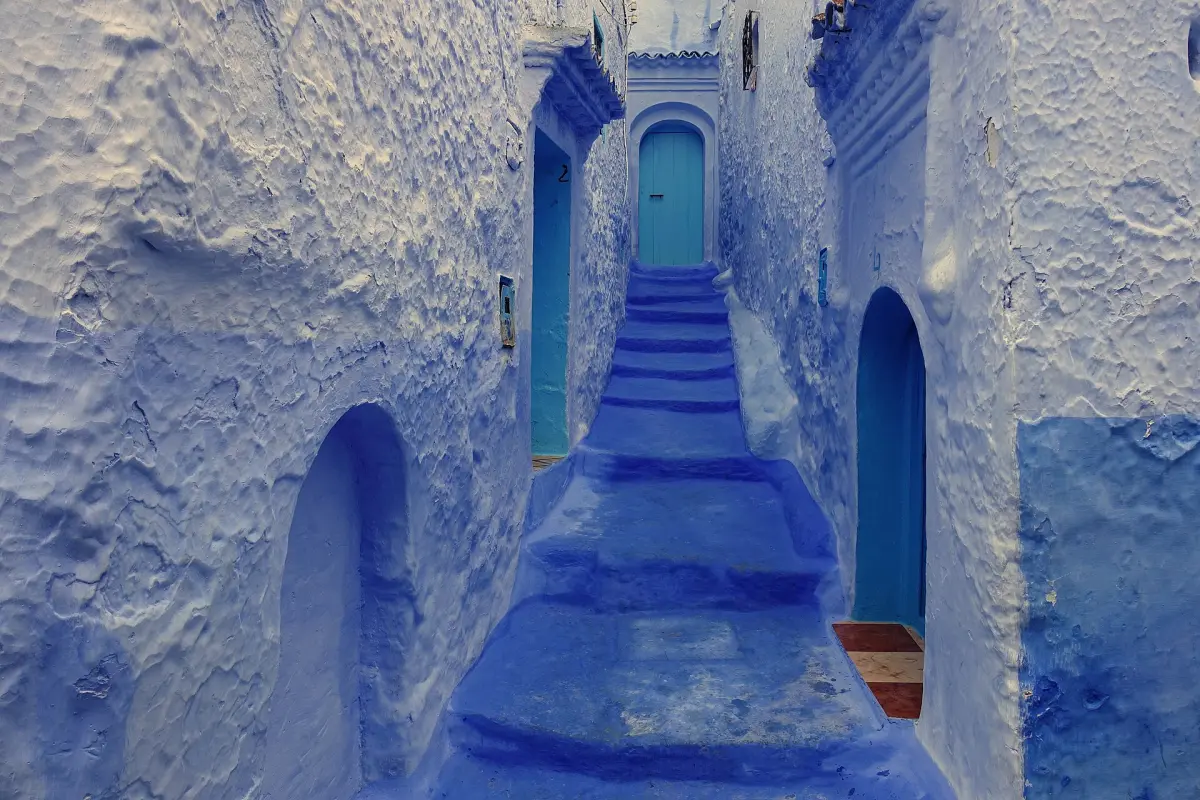
Fès and the north. Fès el-Bali is the largest car-free urban area in the world and the most medieval medina in the Arab world: the Chouara tanneries, the al-Qarawiyyin mosque and university, founded in 859. North of it, Chefchaouen is the blue-washed mountain town, Meknès and the Roman ruins of Volubilis are an easy day out, and Tangier faces Spain across the strait.
The High Atlas and the kasbah road. Imlil is the base for Jebel Toubkal, the highest peak in North Africa, and for Berber-village walks. Over the Tizi n'Tichka pass, Aït Benhaddou is the UNESCO-listed fortified village that has stood in for half of Hollywood's ancient world. Beyond are Ouarzazate, the Dades and Todra gorges, and the palm oases of the Draa valley. The region was hit by the September 2023 earthquake; most villages have reopened and tourism is part of the recovery.
The Sahara. Erg Chebbi at Merzouga has the classic high dunes and camps where you sleep under the stars; Erg Chigaga, beyond M'Hamid, is wilder and a harder drive. Both are a long way from Marrakesh - Merzouga is about 9-10 hours by road - so a desert trip needs at least three days.
The Atlantic coast. Essaouira, a fortified port with a laid-back medina, sea breezes, fishing boats and a kite-surfing beach, is the antidote to Marrakesh's intensity. Casablanca has the Hassan II Mosque, one of the largest in the world, which non-Muslims can tour; Rabat, the capital, is calm and elegant.
Where nobody goes, and should
The Anti-Atlas around Tafraoute is pink granite boulder country with almond trees and villages that see few foreigners. Further south, Sidi Ifni is an Art Deco former Spanish enclave on a surf coast, and the Legzira area has sea arches in red rock.
Closer to the main routes, spend a night in a village in the Ourika or Aït Bouguemez valleys - the 'Happy Valley' - instead of doing the Atlas as a day trip from Marrakesh. And Oualidia, a lagoon town on the Atlantic between Casablanca and Essaouira, is where Moroccans go for oysters.
What to eat and drink
Tagine, slow-cooked in its conical clay pot, is everywhere - lamb with prunes, chicken with preserved lemon and olives. Couscous is traditionally a Friday dish. Pastilla (pigeon or chicken pie with cinnamon and sugar) is a Fès speciality, harira soup breaks the fast in Ramadan, and in Marrakesh, tanjia is meat cooked for hours in the ashes of a hammam furnace. Street food in Jemaa el-Fnaa at night - snail soup included - is an event in itself.
Mint tea is the national drink and a gesture of welcome; refusing a first glass can seem rude. Alcohol is available in hotels, some restaurants and supermarket shops in the big cities, but not in most of the medinas.
Where everything is
Every place named in this guide, on one map. Distances here are short - that is the whole planning trick.
Morocco itineraries, by the kind of traveller you are
Four plans for the same country. They are written as schedules because the hard part here is not what to see, it is what order to see it in.
First time here
7 days
Three nights Marrakesh, two in the desert on the way, two in Fès
Day 1Marrakesh. The medina with a local guide on the first morning - it saves hours of getting lost - then Jemaa el-Fnaa at dusk.
Day 2Gardens and palaces. Majorelle Garden early, the Bahia Palace and Saadian Tombs, and a hammam in the evening.
Day 3Over the Atlas to Aït Benhaddou. The Tizi n'Tichka pass, the kasbah village, and a night in the Dades gorge.
Day 4To Merzouga. Todra gorge, then the long road to the dunes. Camel ride to a desert camp for sunset.
Day 5Sunrise, then north. Dunes at sunrise, then a long drive through the Middle Atlas cedar forests, where Barbary macaques live, to Fès.
Day 6Fès el-Bali. A full day in the medina with a guide: the tanneries from a terrace, the medersas and the souks.
Day 7Fès to home. Fès has its own airport, or the train connects to Casablanca and Tangier.
The Marrakesh-Merzouga-Fès loop is usually done as a three-day group or private tour. The drive is long; a private driver lets you stop where you like.
Hikers
4 days
Imlil as a base, with a licensed guide
Day 1To Imlil. Ninety minutes from Marrakesh. Walk up to the village of Aroumd for the valley view.
Day 2To the Toubkal refuge. A steady five-to-six-hour climb past the Sidi Chamharouch shrine to the refuge at about 3,200 m.
Day 3Toubkal summit. An early start for the 4,167 m summit, then all the way back down to Imlil. Hard, but not technical in summer.
Day 4Village walk. An easy day through Berber villages and walnut groves, and lunch in a family house.
Since 2018 a licensed mountain guide has been required for Toubkal. In winter it needs crampons, an ice axe and experience.
The north
5 days
Tangier, Chefchaouen, Fès
Day 1Tangier. Arrive by ferry from Tarifa (about an hour) or on the high-speed Al Boraq train from Casablanca. The kasbah and the Café Hafa terraces over the strait.
Day 2Chefchaouen. The blue medina, and the walk up to the Spanish Mosque for sunset.
Day 3Akchour. A hike to waterfalls and God's Bridge, a natural rock arch in the Rif mountains.
Day 4Volubilis and Meknès. Roman mosaics still in the ground at Volubilis, and Meknès's great gate on the way to Fès.
Day 5Fès. The medina, slowly.
With kids
5 days
Marrakesh and Essaouira
Day 1Marrakesh gardens. Majorelle and the Menara gardens; save the souks for later.
Day 2Agafay desert. A stony desert 40 minutes from Marrakesh with camel rides and quad bikes - a gentle taste of the Sahara.
Day 3To Essaouira. Three hours to the coast; argan-oil co-operatives and goats in the trees on the way.
Day 4Essaouira. The ramparts with their cannons, the fishing port, and the beach.
Day 5Beach and back. Horse or camel ride on the beach, then back to Marrakesh.
Things to do in Morocco
Eat at Jemaa el-Fnaa at nightMarrakeshPick a busy stall and agree the price first.
Sleep in a desert campErg Chebbi, MerzougaNights are cold from October to April - bring a layer.
Get lost in Fès el-BaliFèsHire an official guide for the first day.
Climb Jebel ToubkalImlil, High AtlasLicensed guide required. Two days.
Walk a UNESCO kasbah villageAït BenhaddouCross the river early for the classic view.
Wander the blue medinaChefchaouenBest at dawn before day-trippers arrive.
Take a hammamAnywhereLocal hammams are cheap; spa hammams are gentler for first-timers.
Tour the Hassan II MosqueCasablancaOne of the few mosques in Morocco open to non-Muslims, with guided tours.
What our explorers actually reached
27 explorers with public maps have marked Morocco, and 9 of them went on to mark the regions they reached. The typical one reached 1 of 16 - 6% of the country - and the most thorough quarter reached 12% or more. Between them, 10 regions still have no mark from anyone.
Typical explorer 6% · top quarter 12%+
The regions they marked most: Marrakech - Tensift - Al Haouz, Souss - Massa - Draâ, Tanger - Tétouan, Grand Casablanca, Rabat - Salé - Zemmour - Zaer.
And where they went instead
52% of explorers who marked Morocco also marked Egypt (vs 26% of everyone)
44% of explorers who marked Morocco also marked South Africa (vs 14% of everyone)
26% of explorers who marked Morocco also marked Namibia (vs 6% of everyone)
Read these as marks on maps, not as reviews: our explorers skew European, and a country nobody has marked is not a country worth skipping. Aggregates only, never an individual, and only from accounts that are public. Read on 24 September 2026.
Practicalities
Money
The dirham (MAD) is a closed currency - you can only get it inside Morocco. ATMs are everywhere in towns; carry cash for souks, taxis and the countryside.
Entry
Most European, UK, US, Canadian and Australian citizens can visit without a visa for up to 90 days. Your passport must be valid for the length of the stay.
Getting around
Trains are good between Tangier, Rabat, Casablanca, Fès and Marrakesh, and the Al Boraq high-speed line runs Tangier to Casablanca in about two hours; its extension to Marrakesh is due around 2029. CTM and Supratours coaches cover the rest.
Dress and etiquette
Cover shoulders and knees in the medinas and villages, women especially. Ask before photographing people, and expect some to ask for a coin.
Flights, hotels and getting around
Marrakesh (RAK) is the main way in. Casablanca (CMN) is the bigger hub; Tangier is a 35-minute ferry from Spain.
These are plain searches on other people's sites - no affiliate tags, no tracking, and we earn nothing if you book. If that ever changes, this line changes with it.
Other people worth reading
We are a map, not a guidebook, and these are better than us on the parts we are thin on. Hand-picked, nothing sponsored, nothing scraped.
MoroccoWikivoyageFrank and practical, with a good section on scams and bargaining.
MarrakechWikivoyageThe city, riad areas and how to navigate the medina.
Visit Moroccovisitmorocco.comThe national tourist office.
ONCFoncf-voyages.maTimetables and tickets for Moroccan trains, including Al Boraq.
Four or five days is enough for Marrakesh and a trip into the Atlas. Seven to ten days lets you do the classic loop from Marrakesh over the Atlas to the Sahara and on to Fès.
Is Morocco safe for tourists?
Generally yes. The main hassles are touts, fake guides and aggressive selling in the medinas, which are tiring rather than dangerous. Women travelling alone may get unwanted attention; dressing conservatively and ignoring it helps.
Can you visit the Sahara from Marrakesh?
Yes, but Merzouga is about 9-10 hours' drive away, so it needs at least three days. For a shorter taste, the Agafay stone desert is 40 minutes from Marrakesh, and Zagora's smaller dunes are about 7 hours.
Is it OK to travel during Ramadan?
Yes. Most sights stay open, though with shorter hours, and tourist restaurants serve food by day. Avoid eating and drinking in public during daylight, and enjoy the lively evenings after iftar.
Been to Morocco?
Mark it, and the regions you reached, and your own map starts answering this question for you.