South Korea is roughly the size of Portugal and home to 51 million people, half of them in greater Seoul - and yet 70% of it is mountains, and an hour out of any city you are on a forested ridge, at a Buddhist temple, or on a coastline of islands. The fast trains make it one of the easiest countries in Asia to cover well in a short trip: Seoul to Busan takes about two and a half hours by KTX.
Most visitors see Seoul and perhaps Busan. The country behind them - Gyeongju's royal tombs and temples, the hanok villages of Jeonju and Andong, the granite peaks of Seoraksan, and volcanic Jeju - is quieter, more traditional, and very easy to reach.
When to go, honestly
Spring (April to early June) and autumn (September to November) are the best seasons. Cherry blossom arrives around late March in the south and early April in Seoul, and autumn colour peaks from mid-October in the mountains to early November in Seoul - both are national events, with crowds to match at the famous spots.
Summer is hot, humid and wet, with the monsoon (jangma) from late June to late July and typhoons possible in August and September. Winter is cold and dry - Seoul regularly drops well below freezing - but clear, with skiing in Gangwon and good-value city trips. Chuseok, the autumn harvest holiday, and Seollal, the lunar new year, fill trains and close many shops for several days.
Five Koreas
Five regions, all linked by fast trains or a short flight.
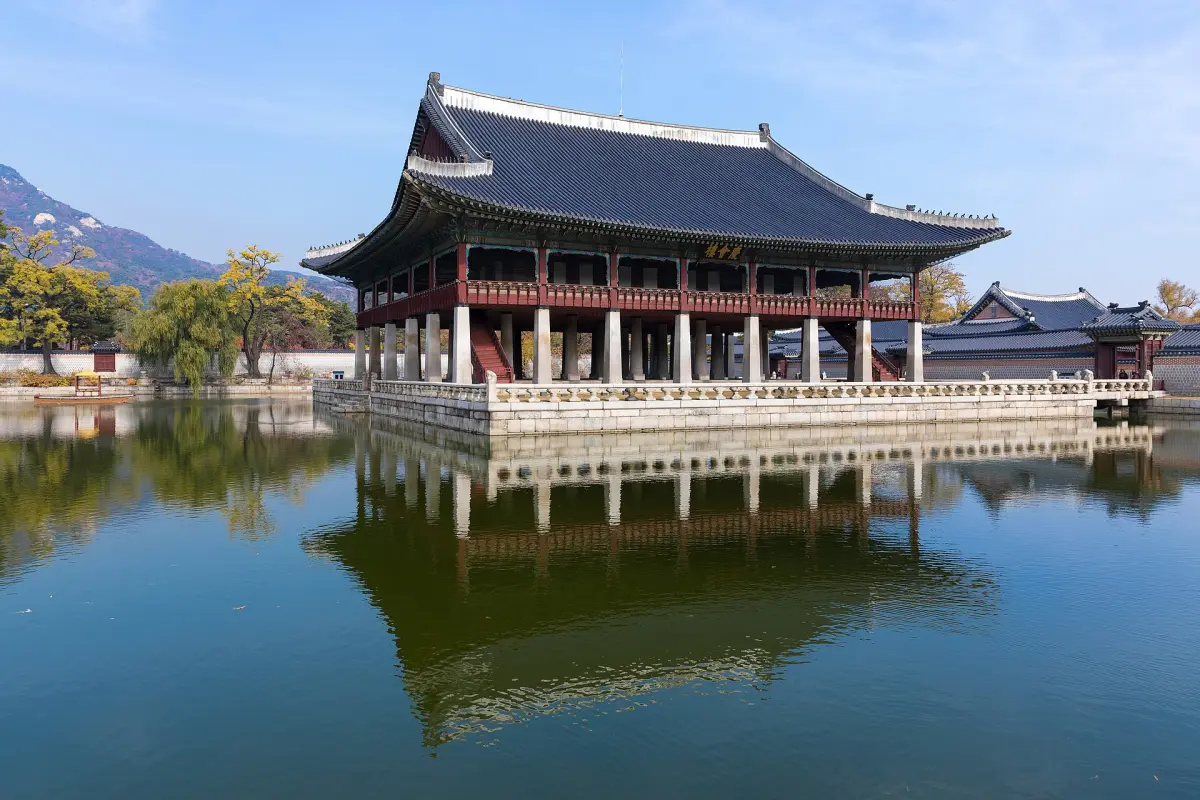
Seoul. Five Joseon-era palaces - Gyeongbokgung is the biggest, Changdeokgung and its Secret Garden the loveliest - the hanok alleys of Bukchon, the Cheonggyecheon stream, markets like Gwangjang and Namdaemun, and neighbourhoods from Hongdae's students to Seongsu's warehouses. N Seoul Tower and the Bukhansan hiking trails give you the view.
Gyeongju and the south-east. The capital of the Silla kingdom for a thousand years, now a 'museum without walls': grassy royal burial mounds in the town centre, the Bulguksa temple and the Seokguram grotto Buddha (both UNESCO), and Donggung Palace reflected in Wolji pond at night. Andong's Hahoe folk village, still lived in, is a couple of hours north.
Busan. Korea's second city and port: Haeundae beach, the pastel-painted Gamcheon culture village on a hillside, the Jagalchi fish market, and Haedong Yonggungsa, a temple on the rocks above the sea.
The east and the mountains. Seoraksan National Park, with granite spires, temples and the Ulsanbawi ridge climb; Gangneung's beaches and coffee street; and the Gangwon ski areas that hosted the 2018 Winter Olympics.
Jeju and the south-west. Jeju is a volcanic island an hour's flight from Seoul: Hallasan (1,947 m, the highest peak in South Korea), the Seongsan Ilchulbong sunrise crater, lava tubes, the haenyeo women divers, and the long Olle walking trails. On the mainland, Jeonju's hanok village is the food capital - bibimbap was born here - and Suncheon Bay's reed wetlands are beautiful in autumn.
Where nobody goes, and should
Tongyeong and the islands of the southern coast - Hallyeohaesang National Park - are a watery maze of green islands, fishing towns and ferries that most foreign visitors never reach. Namhae island's terraced rice paddies drop straight to the sea.
For a temple stay, skip the Seoul programmes and book a night at one of the mountain monasteries - Haeinsa, which holds the 13th-century Tripitaka Koreana woodblocks, or Beopjusa - where you rise at 3am for the chanting and eat in silence. Several dozen temples run English-friendly Templestay programmes.
What to eat and drink
Korean barbecue (samgyeopsal, pork belly, grilled at the table), bibimbap, kimchi stew (kimchi jjigae), naengmyeon (cold buckwheat noodles, a summer staple), and fried chicken with beer - chimaek - are the everyday classics. Markets are the best place to eat: Gwangjang in Seoul for bindaetteok (mung bean pancakes) and raw beef, Jagalchi in Busan for seafood you choose from the tanks.
Meals come with a spread of free side dishes (banchan) that are refilled on request. Soju, the clear spirit, and makgeolli, a milky rice wine, are drunk with food; Korean coffee culture is enormous and every town has a street of design-led cafés.
Where everything is
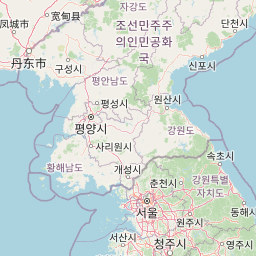
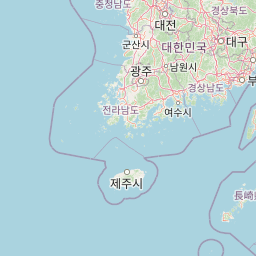
Every place named in this guide, on one map. Distances here are short - that is the whole planning trick.
South Korea itineraries, by the kind of traveller you are
Four plans for the same country. They are written as schedules because the hard part here is not what to see, it is what order to see it in.
First time here
7 days
Four nights Seoul, one Gyeongju, two Busan
Day 1Palaces and Bukchon. Gyeongbokgung (the changing of the guard is at 10am and 2pm; free entry if you wear a hanbok), then the Bukchon hanok village - quietly, people live there - and Insadong.
Day 2Changdeokgung and markets. The Secret Garden tour (book ahead), Gwangjang market for lunch, and the Cheonggyecheon stream in the evening.
Day 3The DMZ. A guided tour to the border, the Third Tunnel and the observatory - the only way to visit, and a sobering day.
Day 4Hiking and Hongdae. Bukhansan or the easier Inwangsan for a view over the city, then Hongdae's street performers at night.
Day 5KTX to Gyeongju. Two hours. The tumuli park, Cheomseongdae observatory, and Wolji pond lit up after dark.
Day 6Bulguksa to Busan. Bulguksa and the Seokguram grotto in the morning, then 30 minutes on to Busan.
Day 7Busan. Gamcheon village, Jagalchi market, and the seaside temple at Haedong Yonggungsa.
Visitors from 22 countries, including the UK, US and much of western Europe, are exempt from applying for a K-ETA until 31 December 2026, so there is nothing to file before a short trip. Check the official site if your nationality is not on the list.
Hikers and nature
6 days
Seoraksan, then Jeju
Day 1To Sokcho. Bus from Seoul, about two and a half hours, and seafood by the harbour.
Day 2Seoraksan. The Ulsanbawi rock ridge - steep metal stairs to a spectacular top - or the cable car to Gwongeumseong for less effort.
Day 3Fly to Jeju. Via Seoul or Yangyang. An evening walk on an Olle trail by the sea.
Day 4Hallasan. The Seongpanak trail to the summit crater lake. Reservations are required for the summit trails; book in advance and start early.
Day 5Seongsan and Udo. Sunrise on Seongsan Ilchulbong, then the ferry to Udo island to cycle its coast.
Day 6Lava tubes and the west. Manjanggul lava tube, and the tea fields of the south-west.
Food and tradition
5 days
Jeonju, Andong and Gyeongju
Day 1Jeonju. A night in a hanok guesthouse, bibimbap where it started, and the market's evening food stalls.
Day 2Jeonju to Andong. Andong jjimdak (braised chicken) and the Hahoe folk village.
Day 3Byeongsan Seowon. A Confucian academy on a river bend, among the most beautiful buildings in Korea.
Day 4Gyeongju. The Silla royal tombs, Gyochon village and a traditional tea house.
Day 5Templestay. A night at a mountain temple - Haeinsa or Golgulsa - with meditation and dawn chanting.
With kids
5 days
Seoul and a day out
Day 1Lotte World. The giant indoor theme park, useful in any weather.
Day 2Palaces in hanbok. Rent traditional clothes and go to Gyeongbokgung free, then the National Folk Museum inside the palace grounds.
Day 3Namsan. The cable car to N Seoul Tower and the love-lock terraces.
Day 4Everland. Korea's biggest theme park and zoo, an hour south of Seoul.
Day 5Han River parks. Bike hire, picnics and fried chicken delivered to your mat - a very Seoul afternoon.
Things to do in South Korea
Wear a hanbok to a palaceGyeongbokgung, SeoulFree palace entry in hanbok. Rental shops are at the gates.
Visit the DMZFrom SeoulTours only; bring your passport. Schedules change with the political situation.
Stay a night in a templeHaeinsa, Beopjusa, Golgulsa and othersBook through the official Templestay site.
Ride the KTXSeoul to BusanAbout two and a half hours. Book at weekends and holidays.
Climb HallasanJejuSummit trails need an online reservation.
Eat at a marketGwangjang, Seoul; Jagalchi, BusanPoint, sit, share.
Walk the Silla royal tombsGyeongjuBeautiful at dusk and lit at night.
Watch haenyeo diversJejuThe women divers at Seongsan and elsewhere, and their museum in Hado.
What our explorers actually reached
28 explorers with public maps have marked South Korea, and 11 of them went on to mark the provinces they reached. The typical one reached 3 of 17 - 18% of the country - and the most thorough quarter reached 35% or more.
Typical explorer 18% · top quarter 35%+
The provinces they marked most: Seoul, Incheon, Gyeonggi, Busan, North Jeolla.
And where they went instead
96% of explorers who marked South Korea also marked Japan (vs 33% of everyone)
75% of explorers who marked South Korea also marked Singapore (vs 26% of everyone)
57% of explorers who marked South Korea also marked Taiwan (vs 16% of everyone)
Read these as marks on maps, not as reviews: our explorers skew European, and a country nobody has marked is not a country worth skipping. Aggregates only, never an individual, and only from accounts that are public. Read on 24 September 2026.
Practicalities
Entry
Nationals of 22 countries - including the UK, US, Canada, Australia, France, Germany, Italy, Spain, Scandinavia and Finland - are exempt from the K-ETA pre-registration until 31 December 2026. Others apply online before flying; check the official K-ETA site.
Maps and apps
For nearly two decades Google Maps could not give walking or driving directions in Korea; the government approved Google's map-data export in February 2026, and full directions are only now arriving. Naver Map and KakaoMap, both in English, are still the reliable choice, and KakaoT is the taxi app.
Getting around
The KTX and SRT fast trains link the main cities; express buses cover everything else. A T-money card works on metros, buses and taxis nationwide.
Money
The won (KRW). Cards work almost everywhere, including at street stalls; some market vendors still prefer cash.
Flights, hotels and getting around
Seoul (ICN) is the main way in. Busan (PUS) is the shorter hop if you are arriving from Japan.
These are plain searches on other people's sites - no affiliate tags, no tracking, and we earn nothing if you book. If that ever changes, this line changes with it.
Other people worth reading
We are a map, not a guidebook, and these are better than us on the parts we are thin on. Hand-picked, nothing sponsored, nothing scraped.
South KoreaWikivoyageThorough and practical, especially on transport and etiquette.
Visit KoreaKorea Tourism OrganizationThe national tourist board, with festival dates and bloom forecasts.
Templestaytemplestay.comThe official booking site for overnight stays in Buddhist temples.
K-ETAk-eta.go.krThe official electronic travel authorisation site. Avoid agency look-alikes.
Common questions
How many days do you need in South Korea?
Seven days covers Seoul, Gyeongju and Busan. Ten to fourteen lets you add Jeju, Seoraksan or Jeonju, which is where the country is at its most traditional and most beautiful.
Do you need a K-ETA for South Korea in 2026?
Not if you are a national of one of the 22 countries on the temporary exemption list - which includes the UK, US, Canada, Australia, France, Germany, Italy, Spain, Scandinavia and Finland - until 31 December 2026. Other visa-waiver nationals need to apply online before travelling.
Does Google Maps work in Korea?
Partly, and it is improving. Korea only approved Google's map-data export in February 2026, so turn-by-turn walking and driving directions are still rolling out. Naver Map and KakaoMap are what locals use, and both have English versions.
When is cherry blossom season in Korea?
Late March in the south (Jeju, Busan, Jinhae) and early April in Seoul, lasting about a week in any one place. Gyeongju's lakeside blossoms in early April are among the most beautiful.
Been to South Korea?
Mark it, and the provinces you reached, and your own map starts answering this question for you.