Norway is long - about 1,750 km from the south coast to the Russian border as the crow flies, and many times that along its fjord-cut coastline - and almost everything people come for is at the edges: the fjords of the west, the Lofoten islands above the Arctic Circle, and the far north, where the sun does not set in summer and the northern lights fill the sky in winter.
It is famously expensive, and it is also one of the easiest countries in the world to travel in: the trains, ferries and buses connect with each other, everyone speaks English, and the right to roam - allemannsretten - means you can walk and even camp almost anywhere in the outdoors. The best trips here pick one region and go slowly, because the scenery is the point and the distances are real.
When to go, honestly
June to August is the main season: long days, open mountain roads (Trollstigen and the other high passes open around late May or June), hiking, and midnight sun north of the Arctic Circle from late May to mid-July. It is also when prices and the famous viewpoints peak. Late May and September are the smart months - quieter, cheaper, and in September the first northern lights appear in the north.
Winter, from November to March, is for the Arctic: northern lights, dog sledding, and snow-covered Lofoten and Tromsø. The polar night in December means little or no sunrise north of the Arctic Circle, but a blue twilight that is beautiful in its own right. The fjords in winter are quiet and many mountain roads are closed.
Four Norways
Four regions, each a trip. Trying to cover all four in one week means spending it in transit.
The fjords. The UNESCO-listed Geirangerfjord and Nærøyfjord are the headliners, with waterfalls pouring down sheer walls. Bergen, with its wooden Bryggen wharf, is the gateway; the Flåm railway drops 866 m from the mountains to the fjord; and the Trollstigen road and the Atlantic Ocean Road are two of the great drives in Europe. Since 2026, smaller passenger ships in Geiranger and Nærøy must run emission-free.
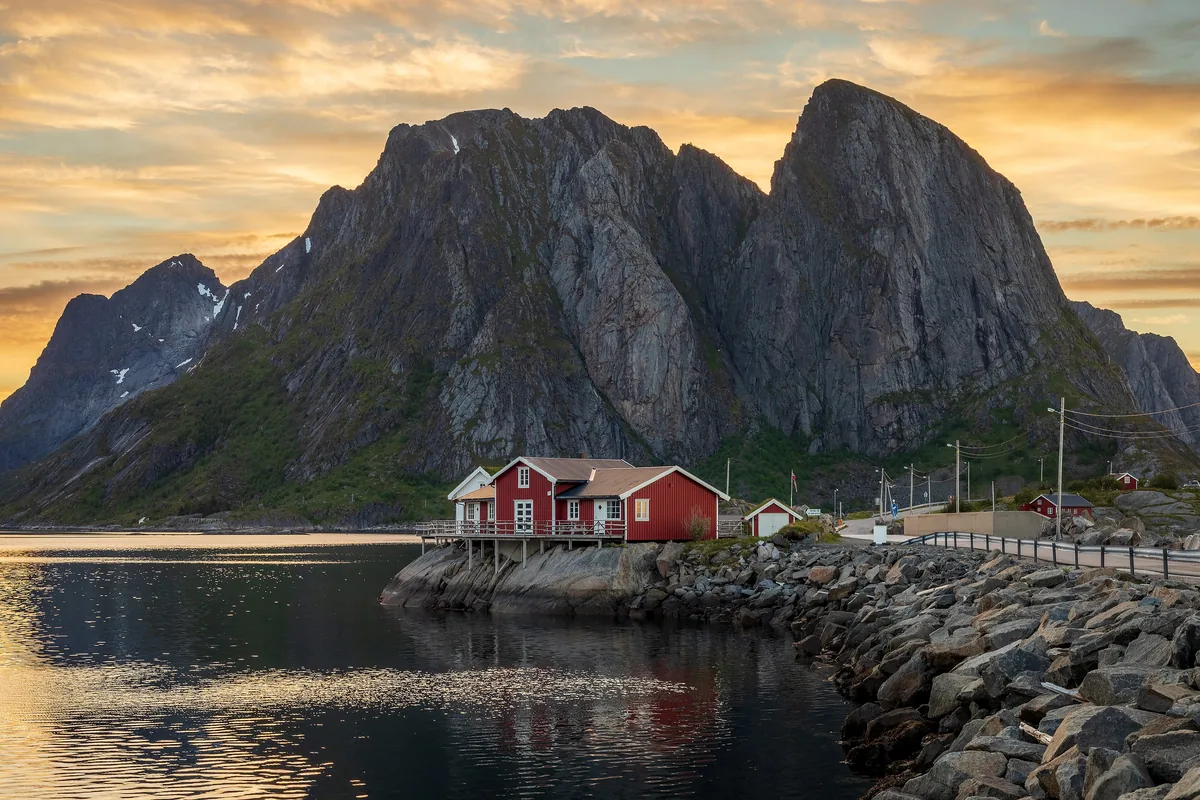
Lofoten. Granite peaks rising straight out of the sea, red fishermen's cabins (rorbuer) on stilts, cod drying on wooden racks, and white beaches that would look tropical if the water weren't so cold. Reine, Hamnøy, Henningsvær and Nusfjord are the famous villages, and the hikes up Reinebringen and Ryten are the famous views.
The Arctic north. Tromsø is the base for northern lights, whales in the fjords in winter and the Lyngen Alps. Senja, south-west of it, is a quieter alternative to Lofoten. Further north, the North Cape plateau and Sami culture in Finnmark.
Oslo and the south. Oslo's opera house you can walk on, the Munch museum, the Viking ship collection on Bygdøy (closed for rebuilding, to reopen as the Museum of the Viking Age) and the Vigeland park. The south coast, around Kristiansand and the white wooden towns, is where Norwegians take their own summer holidays.
Where nobody goes, and should
Senja has almost everything that makes Lofoten famous - jagged peaks, fishing villages, beaches, the Segla hike - with a fraction of the visitors. In summer it is a short ferry and a drive from Tromsø, and another ferry links it to Andenes on Vesterålen.
In the fjords, the Hardangerfjord area, with its orchards, glaciers and the Trolltunga and Vøringsfossen trails, is less crowded than Geiranger. And Røros, a UNESCO-listed copper-mining town of turf-roofed wooden houses on the mountain plateau, is one of the most complete old towns in Scandinavia and barely on the international radar.
What to eat and drink
Seafood is the thing: fresh shrimp eaten on the dock, fish soup, salmon, king crab in the north, and in Lofoten, skrei (spawning cod) in late winter and stockfish all year. Brunost, the caramel-brown whey cheese, goes on waffles and bread. Reindeer and elk turn up on menus in the north and in the mountains.
Eating out is expensive - a main course is often NOK 300-450. Lunch is cheaper than dinner, supermarkets (Rema 1000, Kiwi) are good, and bakeries sell kanelboller, cinnamon buns, that justify the price. Alcohol above 4.7% is sold only at the state Vinmonopolet shops, which close early on Saturdays and all day on Sundays.
Where everything is
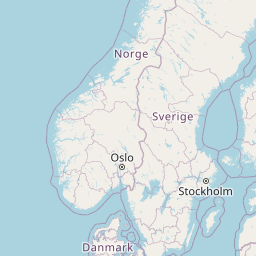
Every place named in this guide, on one map. Distances here are short - that is the whole planning trick.
Norway itineraries, by the kind of traveller you are
Four plans for the same country. They are written as schedules because the hard part here is not what to see, it is what order to see it in.
First time here - the fjords
5 days
Oslo, the Bergen line, Flåm and Bergen
Day 1Oslo. The Opera House roof, the Munch museum, and a walk through Vigeland park.
Day 2The Bergen line to Myrdal and Flåm. One of the great train rides of the world across the Hardangervidda plateau, then the Flåm railway down to the fjord.
Day 3The Nærøyfjord. A quiet electric boat from Flåm to Gudvangen through the narrowest arm of the Sognefjord, then bus to Voss and train to Bergen. The combination is sold as Norway in a Nutshell, but you can book the pieces yourself.
Day 4Bergen. Bryggen, the fish market, and the Fløibanen funicular up Mount Fløyen, or walk up the Ulriken ridge in good weather.
Day 5Geiranger or Hardanger. A long day: the drive or the coastal ferry north to Geiranger, or south-east into the Hardangerfjord's orchards.
It rains in Bergen on more than 200 days a year. Pack for it and it will not ruin anything.
Lofoten
5 days
A car; two nights in Reine, three in Henningsvær or Svolvær
Day 1Arrive. Fly to Bodø and take the ferry to Moskenes, or fly into Leknes or Svolvær. Sleep in a rorbu.
Day 2Reine and Å. Reinebringen's stone steps for the famous view, then down the road to the village of Å at the end of the world.
Day 3The beaches. Kvalvika (a hike in) and the easy white sand at Haukland and Uttakleiv.
Day 4Nusfjord and Henningsvær. A preserved fishing village and a town built across small islands, with its football pitch on the rocks.
Day 5Svolvær and the Svolværgeita. The goat-horned pinnacle, and a boat trip into the narrow Trollfjord.
Wild camping in the most popular spots is increasingly restricted; use campsites or booked rorbuer in summer.
Arctic winter
4 days
Tromsø, November to March
Day 1Tromsø. The Arctic Cathedral, the cable car to Fjellheisen, and your first night out chasing the aurora.
Day 2Dog sledding. A day with a husky kennel in the valleys outside the city.
Day 3Whales or fjords. In November to January, orcas and humpbacks follow the herring into the fjords; otherwise a fjord cruise to Senja.
Day 4Sami culture. A visit to a reindeer herding family, with a lavvu tent, reindeer and joik singing.
Aurora tours drive to wherever the sky is clear, sometimes into Finland. Book one with a flexible route.
With kids
4 days
Oslo and a fjord
Day 1Oslo's museums. The Kon-Tiki and Fram polar-ship museums on Bygdøy, reached by ferry across the harbour.
Day 2The Opera House and Holmenkollen. Walk on the Opera House roof, then up to the ski jump and its simulator.
Day 3The Flåm railway. Waterfalls, a stop at Kjosfossen where the whole train gets out, and the fjord at the bottom.
Day 4A fjord boat. Nærøyfjord with seals and goats on the ledges.
Things to do in Norway
Ride the Bergen line and Flåm railwayOslo - Myrdal - FlåmBook in advance in summer; the Flåm line sells out.
Cruise a UNESCO fjordNærøyfjord or GeirangerfjordElectric boats on the Nærøyfjord are near silent.
Hike to a famous viewpointPreikestolen, Trolltunga, ReinebringenTrolltunga is a 10-12 hour day; do not start late.
Drive the Atlantic Ocean RoadBetween Molde and KristiansundEight bridges hopping across islets. Best in a storm, safely.
Sleep in a rorbuLofotenFishermen's cabins on stilts; book early for summer.
Chase the northern lightsTromsø, Lofoten, SenjaSeptember to March, clear nights.
See the midnight sunAnywhere north of the Arctic CircleLate May to mid-July.
Walk on the Opera House roofOsloFree, and the best view of the harbour.
What our explorers actually reached
30 explorers with public maps have marked Norway, and 9 of them went on to mark the counties they reached. The typical one reached 7 of 21 - 33% of the country - and the most thorough quarter reached 38% or more. Between them, 1 counties still have no mark from anyone.
Typical explorer 33% · top quarter 38%+
The counties they marked most: Oslo, Hordaland, Buskerud, Møre og Romsdal, Rogaland.
And where they went instead
87% of explorers who marked Norway also marked Denmark (vs 36% of everyone)
80% of explorers who marked Norway also marked Sweden (vs 32% of everyone)
73% of explorers who marked Norway also marked Finland (vs 29% of everyone)
Read these as marks on maps, not as reviews: our explorers skew European, and a country nobody has marked is not a country worth skipping. Aggregates only, never an individual, and only from accounts that are public. Read on 24 September 2026.
Practicalities
Money
Norwegian krone (NOK). Cards are accepted everywhere, including for tiny amounts; cash is almost unused.
Getting around
Trains cover the south as far as Bodø; north of that it is coastal ferries, the Hurtigruten coastal ships, buses and short flights. Entur is the one app for tickets across all of them.
Driving
Roads are narrow and slow, with frequent ferries and tolls charged automatically by number plate (AutoPASS) - rental companies pass them on. Mountain passes close in winter.
Costs and taxes
Expensive by any standard. A new 3% visitor levy on accommodation is allowed from 2026, but no town is expected to charge it before 2027.
Flights, hotels and getting around
Oslo (OSL) is the main way in. Bergen (BGO) for the fjords, Bodø (BOO) or Evenes (EVE) for Lofoten.
These are plain searches on other people's sites - no affiliate tags, no tracking, and we earn nothing if you book. If that ever changes, this line changes with it.
Other people worth reading
We are a map, not a guidebook, and these are better than us on the parts we are thin on. Hand-picked, nothing sponsored, nothing scraped.
NorwayWikivoyagePractical on transport and costs, with the right-to-roam rules explained.
Five days covers Oslo, the Bergen railway, Flåm and Bergen. Lofoten needs another four or five on its own. Trying to do both the fjords and Lofoten in a week means spending most of it travelling.
Fjords or Lofoten?
The fjords for waterfalls, trains and classic Norway; Lofoten for dramatic peaks over the sea, fishing villages and beaches. In summer both are excellent. In winter, Lofoten and the north win for northern lights.
When can you see the northern lights in Norway?
From September to March in the north - Tromsø, Lofoten, Senja and Finnmark. You need dark, clear skies; the midnight-sun months from May to July are too bright.
Is Norway really that expensive?
Yes, especially eating out and alcohol. Supermarket lunches, cabins with kitchens and the right to roam - hiking and camping are free - bring it down a lot.
Been to Norway?
Mark it, and the counties you reached, and your own map starts answering this question for you.